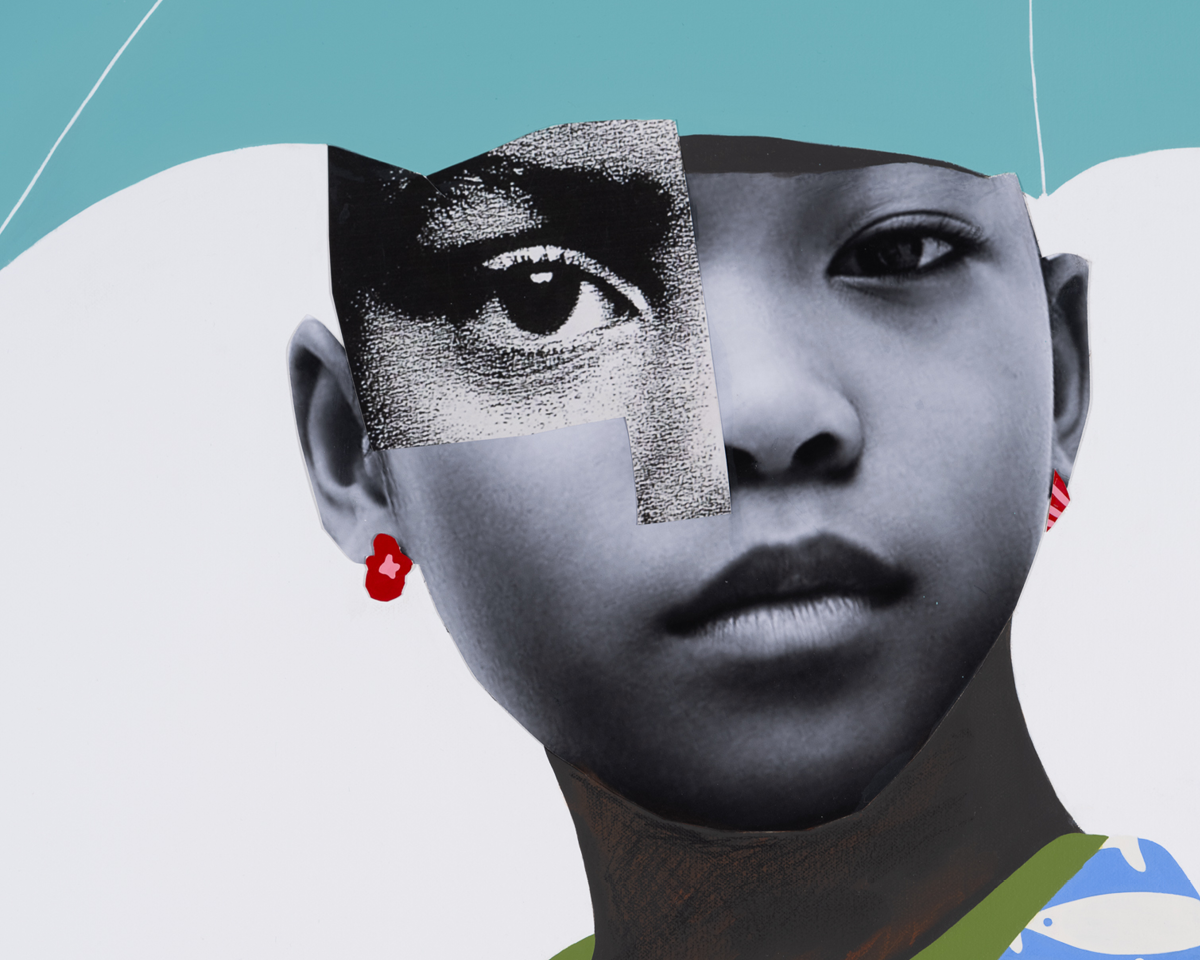
Deborah RobertsWhat the water kept : Ce que l’eau a gardé
Salon 94 presents What the water kept : Ce que l’eau a gardé, a solo exhibition by American artist Deborah Roberts (b. 1962), opening October 18 and inaugurating our new gallery in the historic Jardins du Palais-Royal in Paris.
The exhibition features five mixed-media paintings and two collages, introducing a new series in which a young girl prepares to step into the ocean. Across these works, Roberts considers the Atlantic as both a site of profound historical loss and a space of continuation, asking what remains, what is carried forward, and what might return transformed.
Roberts’s figures appear beneath umbrellas, at the water’s edge, and among fish, their quiet presence set against expanses of blue. The umbrella becomes an intentionally inadequate form of protection against the scale of the ocean, while also evoking broader ideas of safety, freedom, dignity, mobility, and the promises made to—and withheld from—Black bodies. Through paint, drawing and collage, Roberts further explores the passage of bodies and images, bringing together fragments of photographs, patterns, clothing, and historical imagery and placing them under new conditions. What was once an image becomes material for something yet to take form.
The exhibition is accompanied by an essay—written by Emmanuel Olunkwa— reflecting on these themes. Together, the works and text consider what imagination can make possible and set free when history has already determined the ending.
What does water know? What does it keep, conceal, or carry? What does it take? What survives beneath its surface, and what returns changed?
By Emmanuel Olunkwa
In Deborah Roberts’s What the water kept : Ce que l’eau a gardé, girls stand beneath umbrellas, crouch at the water’s edge, and appear among fish. Color accumulates, patterns collide, and bodies hold themselves against expanses of everlasting blue. The water is the Atlantic, carrying with it the history of the Middle Passage and the Black bodies lost within it. But for Roberts, the Atlantic isn’t only a site of death; it is also a place where generations of Black bodies continued. Water keeps without being preserved intact. Bodies pass through it, disappear within it, are carried elsewhere by it. What remains is changed by the conditions of having been there. Roberts begins with this unstable possibility: that disappearance and continuation might occupy the same water.
As a ritual, Roberts writes her way into the work, using language to create the conditions and context necessary to make it. In pages from the notebooks she shared with me, thoughts condense into fragments: “calm as refusal” and “they drowned, we lived.” These quiet mantras occupy the proverbial place of her subjects, making their quietude all the more affecting and exact. What each figure carries need not be performed to remain present.
Against the scale of the Atlantic, the umbrella is deliberately inadequate. It cannot stop the sea or alter what the water knows, yet Roberts places it in the girl’s hand anyway. Its associations with leisure, civility, class, and protection summon a larger set of promotional promises: safety, freedom, citizenship, dignity, mobility, and the expectation that institutions might protect the people subject to them. For Black bodies, these are also historical debts: promises made, rights seized, debts known and never paid. What use is an umbrella against an ocean? Perhaps the same use imagination has against history. Neither changes what happened, but each makes another way of inhabiting its conditions conceivable. She cannot control the water, but she can determine how she occupies it.
The fish begin with their own material history. Caught, sorted, weighed, salted, transported, priced, consumed: a living body becomes commodity through a sequence of actions performed upon it. Beside Roberts’s girls, those verbs cannot remain innocent. Fish and girl enter the same saltwater under different conditions, without either becoming an analogue for the other. Roberts insists upon their coexistence: neither is menace nor victim, neither owns the water, and both inherit it. The metaphor resides not in their likeness, but in what can be done to a body once it has been made available for consumption.
Collage subjects the image to its own kind of passage. A face, limb, photograph, pattern, or piece of clothing is cut from one context and made to enter another; the seam preserves evidence of that movement. Working within the bindings of historical images, Roberts takes fragments already burdened by systems of representation and places those histories under new conditions. The source remains legible without retaining authority over what the fragment can become. Through Roberts’s hand, what was once an image becomes material.
The works’ passage from Texas to Paris extends this geography without resolving it. They move between places differently implicated in the histories of Black bodies, commodity, and circulation already present within the images. Passage does not make histories equivalent any more than Roberts’s fragments become identical through their assembly. Cutting, placing, and reconstituting, she crafts new histories from images that already exist as themselves—or as something other. There is an alchemy to the gesture: what already exists becomes material for what has yet to find its form.
The myth beneath these works imagines that those lost to the Atlantic did not disappear at all, but continued beneath its surface. Roberts does not ask us to mistake imagination for history. She asks what imagination can make possible when history has already predetermined the ending. What the water took is another question. What remains is before us. Indeed, her girls are already unconcerned with the accepted and widespread truths of history; they are occupied instead with the known conditions of their own contemporary existence.
About the artist
Deborah Roberts (American, b. 1962) is a mixed media artist whose work challenges the notion of ideal beauty. Her work has been exhibited internationally across the USA and Europe. Roberts' work is in the collections of the Whitney Museum of American Art, New York, New York; Brooklyn Museum, New York, New York; The Studio Museum in Harlem, New York, New York; LACMA, Los Angeles, California; the Virginia Museum of Fine Arts, Richmond, Virginia, Guggenheim Museum, New York, New York, and the Modern Art Museum of Fort Worth, Fort Worth, Texas, among several other institutions. She was selected to participate in the Robert Rauschenberg Residency (2019) and was a finalist for the 2019 Outwin Boochever Portrait Competition, as well as the recipient of the Anonymous Was A Woman Grant (2018), and the Pollock-Krasner Foundation Grant (2016). Texas Metal of Arts Award (2023) Roberts received her MFA from Syracuse University, New York. She lives and works in Austin, Texas.
—
The opening will be on Sunday, October 18, 5 – 8pm at 30 Galerie de Monpensier in the Jardins de Palais-Royal. Opening hours are Tuesday to Saturday, 11am – 6pm.
For press inquiries, please contact icart@insightcommunications.cc.
For information about Deborah Roberts please contact alissa@salon94.com.
For information about the gallery, please contact paris@salon94.com.