Tom Sachs"FURNITURE"
Installation Views
Salon 94 Design presents a comprehensive full building takeover by artist, designer, bricoleur Tom Sachs. The exhibition traces the arc of his career, from his formative years in London to exclusive new work spanning furniture, ceramics, lighting, sculpture, and painting – revealing the breadth of Sachs's practice and his commitment to treating every medium with the same material intelligence and experimentation. Showcasing Sachs as a maker in the fullest sense, as comfortable forming a piece of plywood into a chair as he is designing and electrifying a lamp.
In 1987, while enrolled at the Architectural Association in London, Sachs took a class with designer Tom Dixon that challenged students to build furniture from materials scavenged from the street. Learning to use salvaged materials such as Victorian railings and industrial castoffs helped lay the foundation for what would become a defining practice of bricolage. Bricolage is the art of building and problem-solving from whatever everyday materials are immediately at hand. Wood, duct tape, foamcore, epoxy resin: in Sachs's hands these are not humble substitutes for finer things but the point entirely – a deliberate collapse of the hierarchy between high and low materials, and an insistence that the evidence of making should always remain visible. The malleability of plywood, the strength of a bolt, the honesty of painted, cut lines: these are his palette.
That same obsessive attention to material extends to the objects in the exhibition. Sachs does not distinguish between the structural and the incidental, as both are opportunities for meaning. The new Odyssey series of upholstered seating introduces a highly developed foam nestled inside hand-stitched leather. His lamps include miniature Hello Kitty pulls, and gold-lined chawans modelled after traditional Japanese tea bowls are turned upside down to act as reflective shades for his lights. These details are a test of the viewer's attention; every element of an object points to a decision.
Underpinning the work on view is Sachs's conviction that furniture, sculpture, and painting are not separate disciplines but a single unbroken lineage. He traces his own practice through Frank Gehry back to Charles and Ray Eames, who encountered Isamu Noguchi at Cranbrook; Noguchi, in turn, apprenticed under Brancusi, who had worked in Rodin's studio. For Sachs, we make our own history — and a chair and a bronze are expressions of the same impulse. It is all, ultimately, sculpture.
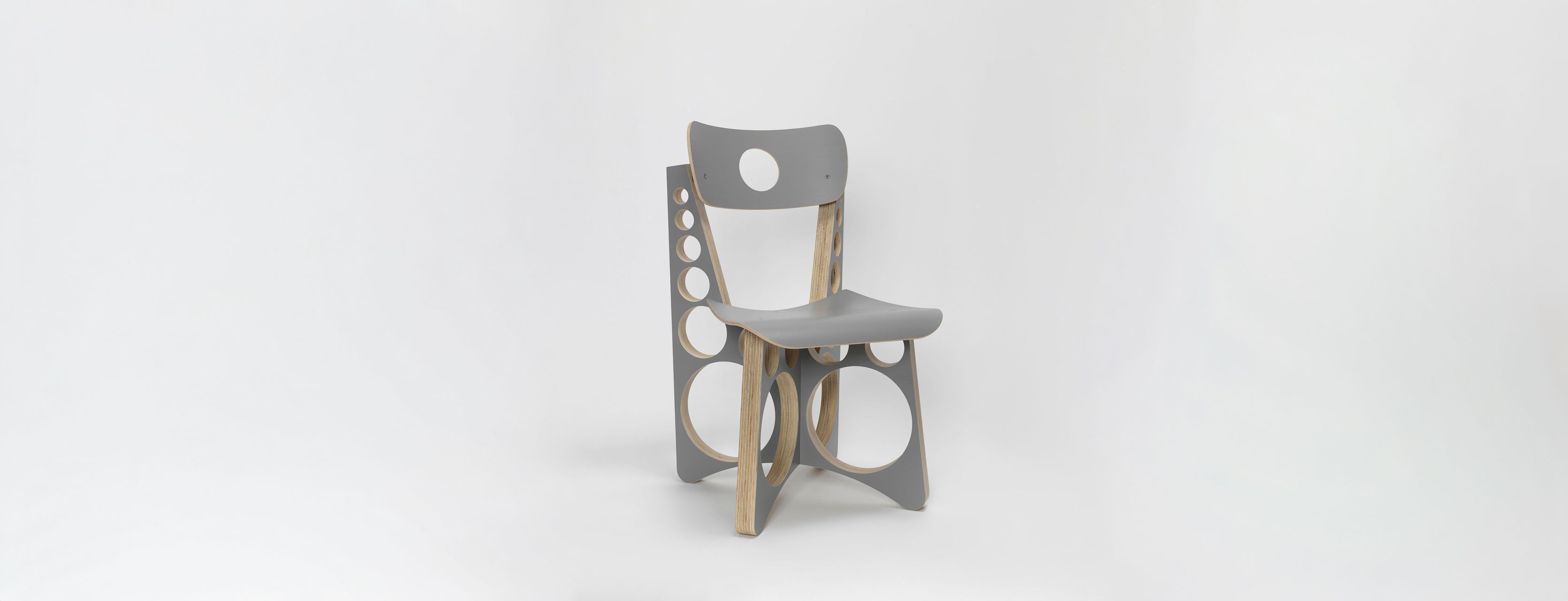
Sachs spent two years in Frank Gehry's Los Angeles furniture shop, where he learned focus and precision. He was there as Gehry developed his celebrated bent plywood chair series for Knoll. It was a first-hand encounter with the democratic promise of a material that Eames and Saarinen had explored at Cranbrook decades earlier. Those chairs were a kind of manifesto: that good design needn't be exclusive, that something as commonplace as plywood could be coaxed, through craft and ingenuity, into something both beautiful and accessible. Sachs's Shop Chair carries that inheritance forward with a characteristically pragmatic twist: the backrest is mounted on rubber flex-mounts – an echo of Carlo Mollino's 1953 Lattes Chair, giving the chair a responsiveness. It is a quiet but telling detail: Sachs is not simply referencing his forebears but solving a problem, improving on it, and leaving the evidence of that thinking fully visible. New and exclusive colors of the Shop Chair in Snappy Blue and Black are to be released for this exhibition.
"Furniture" opens with Sachs's new Walnut Jeanneret Tables, which will host ceramic works by Japanese-born ceramist Shoko Suzuki. On May 20th the exhibition will transform to host works by artists Mary Frey, JJ Peet, Pat McCarthy, Luc Hammond-Thomas, and Sachs, who together form Satan Ceramics. Each of the artists brings an independent practice in sculpture, painting, photography, or installation. Together they pool those sensibilities into ceramic objects that sit at the productive edge of function and art. The group, which formed on the conviction that making is inseparable from living, first showed together over a decade ago at Salon 94. They believe that process, politics, labor, the handmade, humor, gossip, danger, history, and punk sensibility are all bound up in the integrity of the material and the sincerity of the object. As Frey puts it: "Our weekly ritual takes place within the clubhouse where we eat together, share knowledge, discuss, make pots, talk shit and dream."
Rounding out the exhibition is a new series of sculptural lamps. Characteristically assembled from found and fabricated components, the works cast both literal and conceptual light on a bricolage practice now spanning almost four decades.
With inquiries, please reach out to trang@salon94.com
For press inquiries, please reach out to gina@companyagenda.com
Press
Puck
Wallpaper*