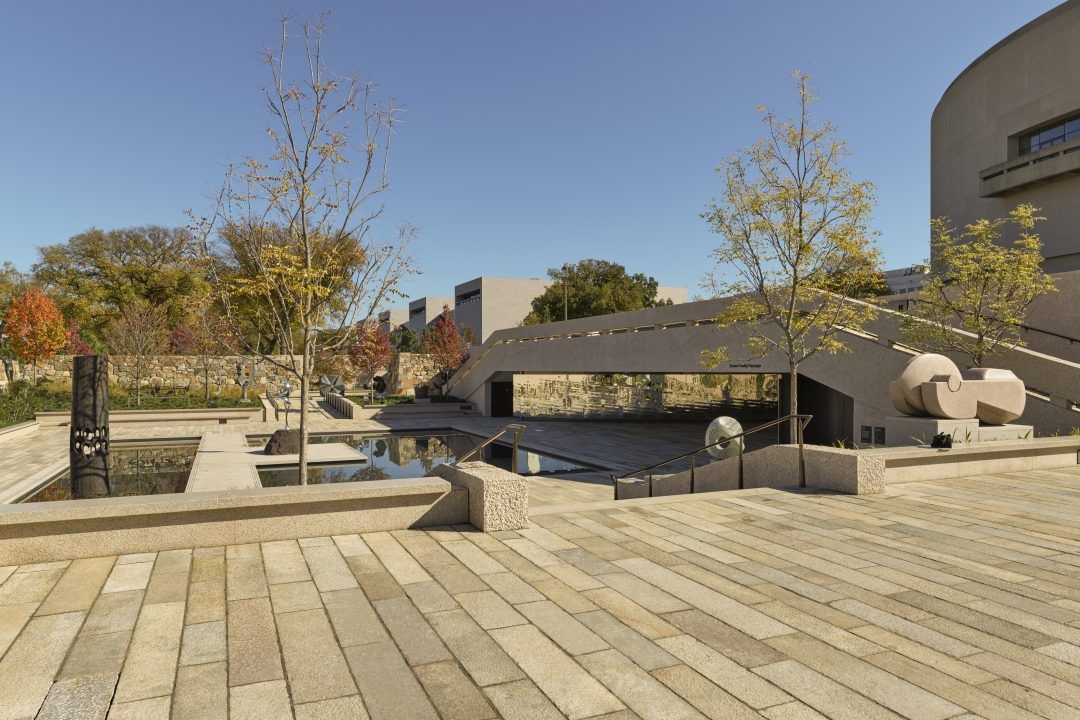
Raven HalfmoonSculpture Garden and Plaza
The Hirshhorn Sculpture Garden reopened to the public on Saturday, Oct. 31, 2026, following a four-year transformation of its 1.3-acre landscape. The revitalized Garden, which sits immediately on the National Mall, is able to welcome more passing visitors and display more works from the national collection of modern and contemporary art, ranging from outdoor sculpture to time-based work to performance art.
Nearly sixty sculptures—an increase of 50% from the previous installation—have been installed in the Sculpture Garden and on the Museum’s Plaza within a landscape of almost 30,000 new trees and plants. Architect and artist Hiroshi Sugimoto has reimagined the Garden, adding his vision to the palimpsest of Gordon Bunshaft’s original 1974 design and Lester Collins’s 1981 revision. Sugimoto’s plan has restored Bunshaft’s long-closed underground passageway as an artwork unto itself: Passage of Reflectance (2026) is a reflective stainless-steel sculpture that adds light and playfulness as it reconnects the Garden to the Plaza to create a seamless visitor experience.
Sugimoto’s vision also introduces hand-cut, dry‑stacked stone walls that emphasize the importance of stone to both Bunshaft’s original design and the evolution of sculpture itself. These walls shape distinct areas and invite exploration. In the new East Galleries, for example, important Modernist bronzes by Auguste Rodin, Henri Matisse, Henry Moore, and others appear alongside recent acquisitions and commissions by artists from around the world. The stone surfaces provide a timeless backdrop for both sculpture and performance.
Architectural updates throughout the Garden expand public access with five entry points, including a wider “front door” on the National Mall and broad ramps from the north and south. New east and west overlooks and flexible spaces for commissions, performances, and time‑based artworks enhance the experience, particularly in the Central Galleries and on the West Lawn. Seating and shade have been increased across the Garden as well.
The foundational Modernist works in the East Galleries, including five Moore sculptures and two by Barbara Hepworth, reflect Joseph H. Hirshhorn’s ties to both artists as friend and patron. Nearby, four sculptures by David Smith, arranged in a central planting bed, highlight the artist’s groundbreaking contributions to Abstract Expressionism via his innovative use of welded metal. Additional works in the Garden gifted by Joseph Hirshhorn include sculptures by Rodin, Lucio Fontana, Alberto Giacometti, Willem de Kooning, Joan Miró, Pablo Picasso, Germaine Richier, and Tomonori Toyofuku.
The Garden’s Central Galleries, where the entrance to the passageway sits, introduces an expanded water feature that can be filled to create a reflective, cooling surface, or drained to accommodate seating for performances, artists’ talks, and educational events.
The Garden’s West Lawn is a green space dedicated to special presentations and ringed by recent acquisitions from the American artists Raven Halfmoon, Lauren Halsey, and Liz Larner. Yoshitomo Nara: Sentinels of Stillness (Oct. 31, 2026–Nov. 7, 2027), a focused presentation of new sculpture, inaugurates this outdoor gallery.
The Sculpture Garden’s Oct. 31 reopening featured free public programs, pop-up talks by artists with works installed in the Garden, a children’s ribbon cutting, and art-making activities across the Hirshhorn campus.
Press
The New York Times
The Art Newspaper
Art Basel